
Thursday, August 19, 2010
No Friday Egg!
So sorry, but I will be unable to post a Friday Egg for this week or next week. I hope to get back to my regularly scheduled egg postings on Friday, September 3rd. I promise!


Saturday, August 14, 2010
Friday Egg

Better a day late than none at all. I apologize for the delay.
A traditional deer egg, but with a fun twist on the eternity band.


I hope you enjoy it! Now, back to taking care of the small and demanding toddler...
Friday, August 13, 2010
Technical Difficulties!

Sorry folks, looks like Flickr is down this evening. I will have to post the Friday Egg tomorrow, sorry for the delay...
Friday, August 6, 2010
Friday Egg

Back to basics this week with a traditional star pattern done on a goose egg. This is based off of a pattern from the Ukrainian Gift Shop's series of books on Pysanky. This is out of Design Book 1.
This pattern always reminds me of when I started doing Pysanky because it was the first complicated design I ever did that worked out. I was so proud of that first egg with this design.
Has anyone else done this pattern? I'd love to see photos!


Friday, July 30, 2010
Friday Egg Tutorial!

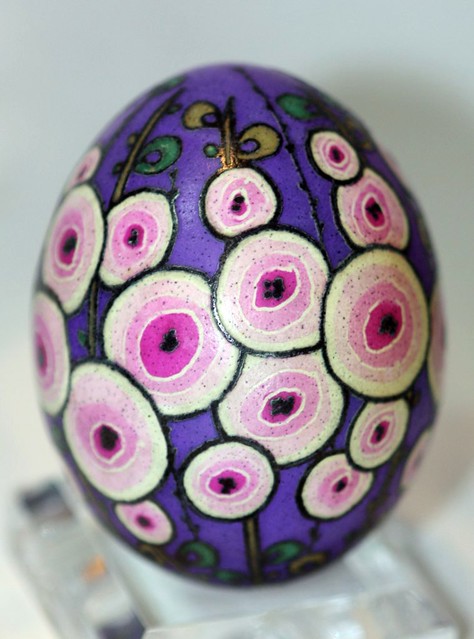
So without further ado, let us begin.
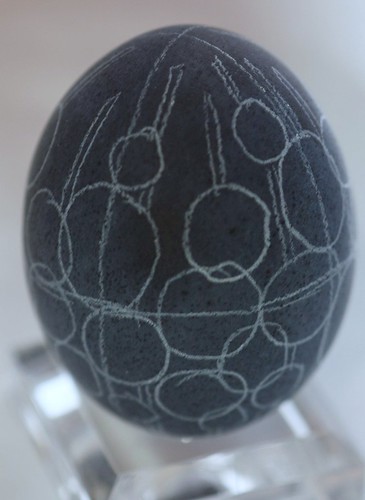
I started with a white egg, drained and cleaned, with the drain hole plugged up with a bit of wax and sealed. I dyed the egg Black, making sure to turn it every few minutes so the egg would be evenly dyed and very dark. It is important to make the egg as deep a color (or in this case, non-color) as possible so that the outlines will be visible and obvious in the final egg. There's nothing more disappointing that finishing the last layer of wax and melting it all off to reveal something kind of boring, lame and without definition.
Once the egg was as dark as I needed, I dried it off and drew a few guidelines. You can see I drew horizontal and vertical guidelines, dividing the egg into 8 equal sections. It is not imperative, but just something I do so that I always know where I am going. I used a white colored pencil for this so that the lines would be visible against the black.
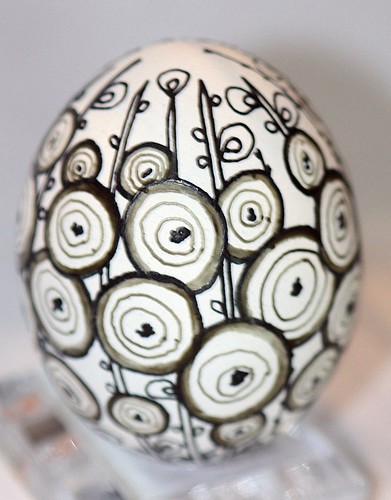
After our guidelines are in place, we are ready to start waxing! For the circles, I used a Medium point electric kistka, and I used a fine point for the stems and leaves. I want the lines to be pretty chunky and sturdy because I will be etching the egg in the next step. If the wax lines are too fine, they can be etched away. After all my outlines are done, I wash some of the black dye off with Ivory dish soap (pretty much any soap will do, but avoid the ones with lotion in!) then put in full strength vinegar for several minutes to etch the surface.
This is how the egg looks after waxing the black dye layer and then etching:

Now it is time to wax over the areas of the egg we want to remain white. I like to go from a dark center to a lighter edge on the flowers, so using the Medium kistka I draw a thick line right up against the black line at the edge of the flower. Using the fine point kistka, I draw concentric circles inside the flowers for my color layers. If you like, you can skip this step and not separate the layers with a white line.
Next we decide what color we want the flowers to be. I chose Pink because it is a deep enough color to be able to dilute it with washing two more times.

As you can see here, we will cover the inner circle of the flower with wax. After all the deep pink areas are covered, it is time to wash the color to half strength or so. Just put the egg under running water, rolling it around in your hand and checking every few seconds to make sure you don't over-wash. If you do, just re-dye it pink and wash it again until you achieve the color intensity you like.

Now cover the next circle with wax and then rinse the egg under running water again until you get the color you like then dry and apply wax to this final circle.
At this point, we will be changing gears color-wise, so it is a good idea to wash off all the dye with Ivory soap.
I used Harvest Green for the stems and some of the leaves. It is slightly gray and dull, but because the pink is so bright, I didn't want the green and the pink to be the same intensity and duke it out for supremacy. I want a peaceful little egg.

You can see in the middle that I blobbed! Sometimes wax just decides to plop off all at once. Usually I can catch it in time, but this one snuck by me. I will show you how it looks once I melt the wax off.
I wanted to use two different greens on the leaves, just for added interest. I chose Jade Green to finish this layer.

Now for the final color - I chose Violet, but you can choose anything you like. I tried dipping it directly from Jade Green to Violet, but the color was a bit too muddy, so I washed the egg back down to white and put it in Violet.

After it dried for a couple of hours (see last Friday Egg for why I waited!), I put the egg in the toaster oven in a grocery store bought foil pan at 200 degrees F and melted the wax off. You can also do this in the microwave, but you MUST OPEN THE SEALED END OR THE EGG WILL EXPLODE!!! Sorry to shout, but it is enough to make you want to lie down for the rest of the day when that happens. I want you to be happy at the end of this, not sad. For the microwave, take a heated kistka tool and put it through the sealed end to unseal it. Nestle it in a paper towel that is placed in a small microwave safe bowl and heat 10 seconds at a time. When you see the wax get shiny, take it out and wipe off the wax. IT WILL BE HOT! Sorry to shout again, but it hurts to get molten beeswax on your fingers. I really like the low-key toaster over approach, but it is up to you.
Look closely at the next photo and you can see where I blobbed. I don't think it detracts from the egg at all, and is really not terribly noticeable so I am not going to worry about it. I pronounce the egg done!

You can really see in the next photo how the black lines are etched. All the other colors are lower and less shiny than black because the shell is roughed up from etching.
Happy Friday, everyone! I look forward to seeing everyone's Hollyhock eggs.
Friday, July 23, 2010
Friday Egg
A traditional pattern on a goose egg today, with some non-traditional colors.
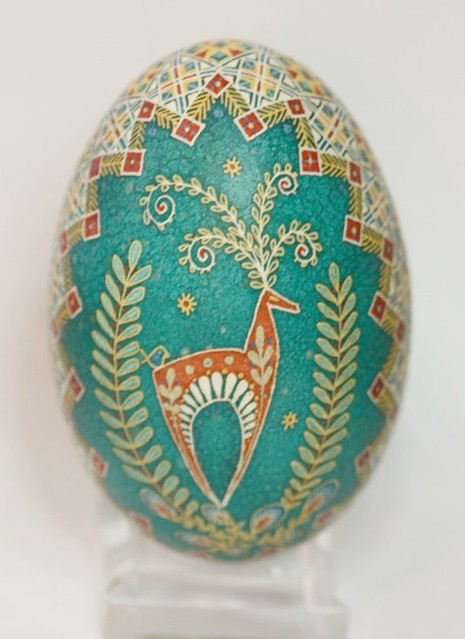
I started with a white goose egg, and worked on a wide and intricate eternity band. Next was Sunflower Yellow, Harvest Green, Bright Green, Peacock Blue, Harvest Orange, Scarlet and a final color of Turquoise. I am not totally happy with this egg. The final color looks uneven and blotchy. I should have let it sit longer after the final dye bath. When I melt the wax off an egg that is still humid on the inside from a lot of dye baths, the humidity is forced through the pores of the egg when the air heats up and adversely affects the dye. I like the plant under the feet of the deer and the eternity band turned out pretty well. Sometimes it is difficult for me to get the geometry right on these wide bands because the squares squish up as they go around the more narrow top of the egg and can sometimes look awkward.
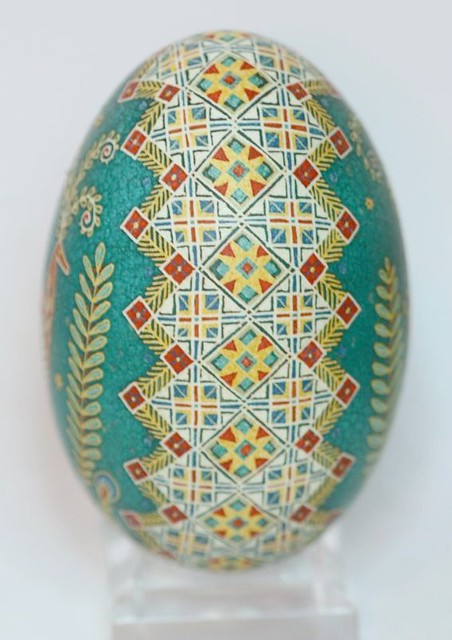


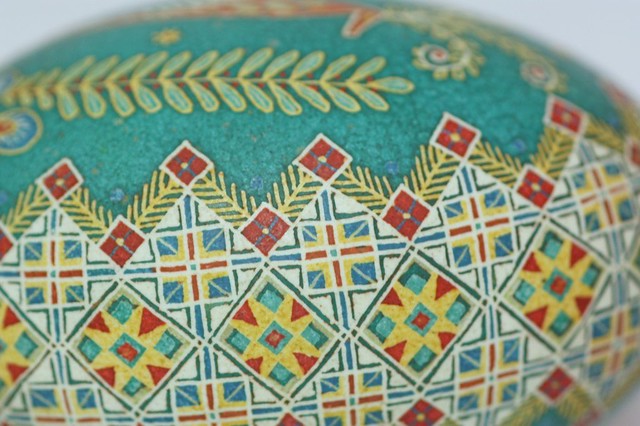
I started with a white goose egg, and worked on a wide and intricate eternity band. Next was Sunflower Yellow, Harvest Green, Bright Green, Peacock Blue, Harvest Orange, Scarlet and a final color of Turquoise. I am not totally happy with this egg. The final color looks uneven and blotchy. I should have let it sit longer after the final dye bath. When I melt the wax off an egg that is still humid on the inside from a lot of dye baths, the humidity is forced through the pores of the egg when the air heats up and adversely affects the dye. I like the plant under the feet of the deer and the eternity band turned out pretty well. Sometimes it is difficult for me to get the geometry right on these wide bands because the squares squish up as they go around the more narrow top of the egg and can sometimes look awkward.
Friday, July 16, 2010
Friday Egg

Happy Friday! Here's a sweet little brown chicken egg, transformed into a strawberry garden. I waxed the basic lines on a regular brown egg, as you can see then etched the eggshell down to white with vinegar (the vinegar eats through eggshell). I filled in the flowers with wax, taking advantage of the natural white color of the egg. I dyed the egg light green and waxed, then a darker green for the larger leaves, next dark red for the strawberry seeds (which you can't really see so that was kind of a waste of time!) At this point I washed all the color off because my next color is Scarlet, which is lighter than Dark Red and following the normal progression of light to dark, this would not work. I have experimented with the color progressions a bit and will have to do a post sometime about the bizarre outcomes (red over dark green produces beige!). After Scarlet, I realized that I needed a little pop of bright color, so I washed it again and dyed it Sunflower yellow for the little dots. Final dunk in black and we are all done!


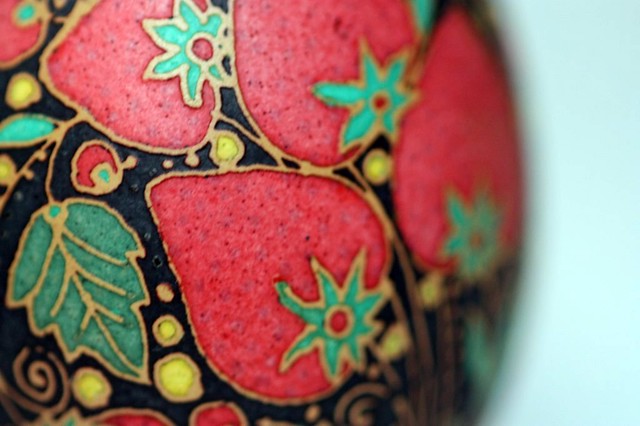
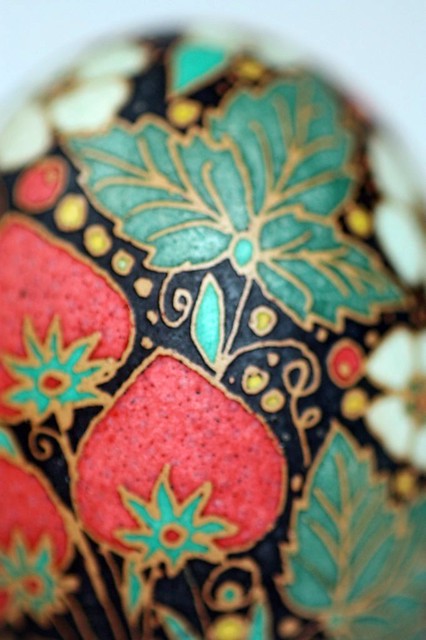

I really like it a lot! Will have to do more with fruits and vegetables. They are somehow more "friendly" than flowers, if that makes sense.
Have a great weekend!
Subscribe to:
Posts (Atom)